
When the lockdown first started, I found that I didn’t really mind it. While I kept social distancing in mind, I did not find that I was impacted very much. I continued going on trips with friends and pretty much lived life as normal. The main differences I noticed were more people on the path during the morning walk and a few people were starting to wear masks. I did feel some concern for those with pre-existing conditions, but didn’t really consider that I need to do something about it. From my perspective, the coronavirus felt like a bad flu which spreads pretty easily.
Since then there have been a number of changes. Mandatory masks when in public areas, lines outside of stores, no group activities, and a curfew advisory have made the fact we are in a lockdown apparent. As the weeks have drawn on, I have been finding that a large part of myself is getting annoyed/angry about the lockdowns. Some thoughts I have had include:
- Why should everyone need to be in lockdown? Why not let people decide for themselves if it is worth the risk?
- What is the timeline for these guidelines and orders? What needs to happen before they are lifted?
- How many of these guidelines and orders are backed by data? If I need to sneeze, is sneezing into a mask better than a sleeve? Is normal breathing a vector for the disease?
Because of my negative reaction, I think it will be useful to do some research to see what effect the lockdown is having. To start, I am curious about how locking down has prevented the spread of the disease to critical groups. Below is a graph of COVID related hospitilizations by age over the past 2 months (https://gis.cdc.gov/grasp/COVIDNet/COVID19_5.html):
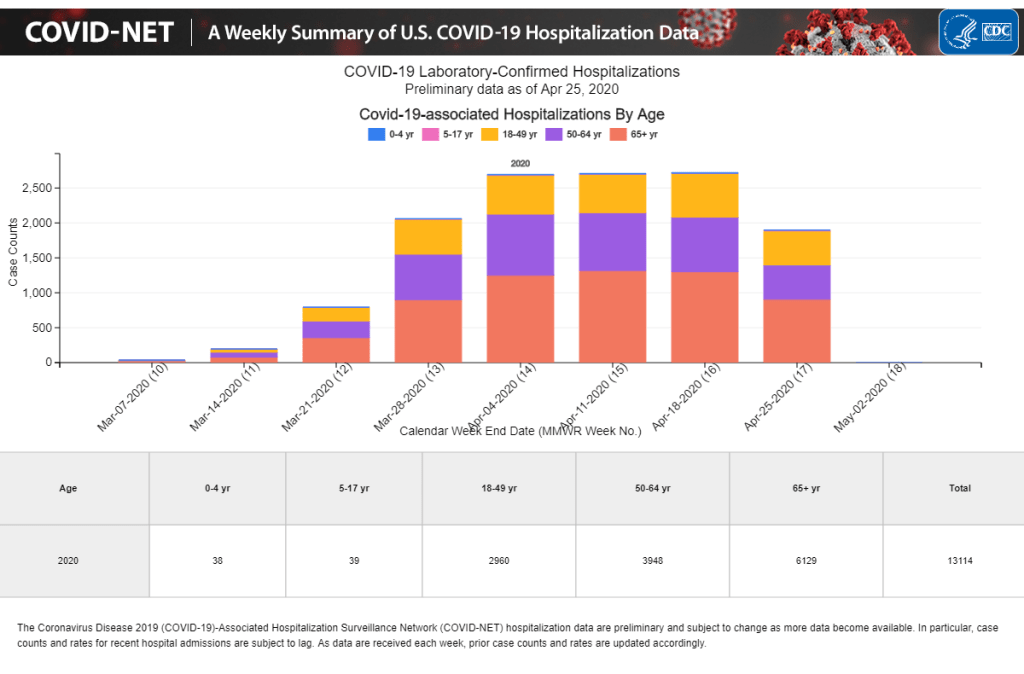
The above chart suggests that measures taken across the country have been effective at reducing the rates of hospitalization. In this chart, we can see that the infection rate has reduced from 2,721 new cases per week to 1900 new cases per week. A reduction of around 30%. This is more than I expected to see though it does make sense. Because disease spreads through contact, social distancing seems like it should reduce the frequency of infections and provided more infections lead to more hospitalizations the above chart seems in line.
Given the primary reason for the lockdown is to reduce the frequency of infections, it is worth understanding the benefits of reducing the frequency of infections. From looking around, it seems like we are practicing social distancing for the following reasons:
- Due to the exponential infection rate of the virus, we need to slow the infection rate or we risk running out of hospital resources. By socially distancing, we allow ourselves time to increase hospital resources, and slow the influx of new patients.
- The longer we can prevent each person from being infected, the greater the chance of us developing an effective treatment or vaccine.
I think I tend to agree with both points. It does seem like social distancing is worthwhile to prevent hospitals from needing to turn away people in critical condition due to lack of resources. Also, having a treatment/vaccine will reduce the number or people who need critical care. First let’s look at the progress on vaccine/treatment development.
Recently, a broad spectrum anti-viral drug ‘remdesivir’ has shown promise (https://www.niaid.nih.gov/news-events/nih-clinical-trial-shows-remdesivir-accelerates-recovery-advanced-covid-19) in both reducing mortality(31%) and reducing hospital stay (31%) for patients in a double blind study. The mortality improvement is not considered statistically significant, but is reasonably close (.059). Also, it seems like a number of vaccines are in early stages of testing also. Optimistic estimates place the time to an available vaccine between 6 and 18 months.
Regarding hospital overload, https://covidactnow.org/ contains a good aggregation of hospital resource data. Using MA as an example, we can see the projection is all hospital resources will be used by May 11 if all restrictions are removed.
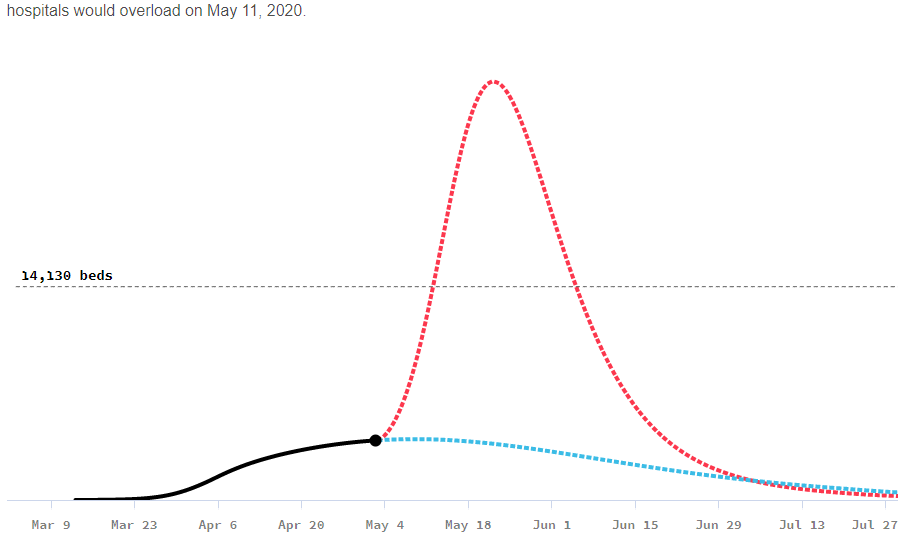
The main concern with this is that the bottom line assumes all restrictions will last for the next 3 months. The projection for MA shows by July 28, 70% of the population will have been infected if we lift all restrictions. If we continue with restrictions, 42% will have been infected. At what point have enough people been infected that there is effective herd immunity? According to one study, the likely range is between 60 and 70%(https://www.medrxiv.org/content/10.1101/2020.04.27.20081893v1).
Putting it together
Looking into the lockdown has helped me realize how limited what I know is. Still, I feel I am more informed now than I was before starting this adventure. I have a better understanding of how our actions are helping and to what end we are working toward.
In general, my thoughts are social distancing efforts are effective at slowing the spread of the virus, but I am not sure that enforced distancing is the right course of action. In my opinion, the target should be to release all available information on risk levels to the public and recommend timelines for stopping lockdown efforts based on these risk factors. By doing this, the rate of infection should be smaller as each group stops lockdown. Should resources become constrained, the timeline can be pushed back.
 Snappy Apples